
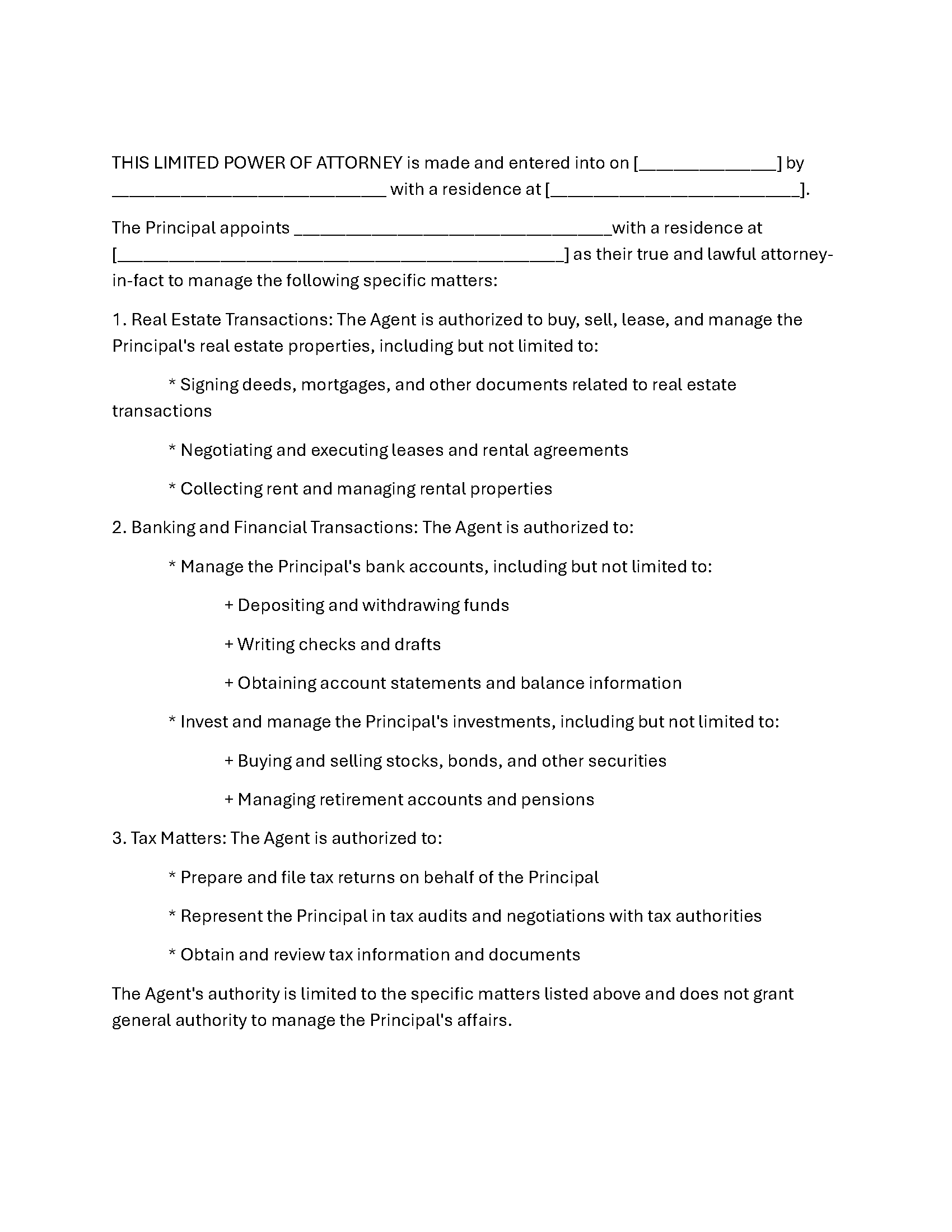
Limited Power of Attorney Form
Authorize an agent for real estate, banking, and tax matters
$3.99
NON-ATTORNEY DISCLOSURE*
* Our services are limited to preparing and notarizing documents and providing general information about the document preparation process. We do not provide legal advice, and our services should not be considered a substitute for the advice of a licensed attorney.
A limited power of attorney (LPOA) is a legal document that grants an individual, known as the agent or attorney-in-fact, the authority to act on behalf of another individual, called the principal, in specified matters. Unlike a general power of attorney, which provides broad and sweeping powers, a limited power of attorney restricts the agent's powers to particular transactions or situations. When considering whether to establish a limited power of attorney, it is essential to carefully outline the scope of authority that the agent will have. This can include specific tasks such as managing real estate transactions, handling bank accounts, overseeing investments, or making decisions related to medical care. The principal can delineate the authority as narrowly or broadly as they choose, provided that the limitations are explicitly stated in the document. ### Purpose of Limited Power of Attorney The purpose of a limited power of attorney varies for different individuals but generally includes: 1. **Convenience**: A limited power of attorney allows the principal to delegate responsibilities to someone they trust, making it easier to handle specific legal or financial tasks without requiring their direct involvement. 2. **Specific Transactions**: Whether buying or selling property, filing tax returns, or handling business affairs, a limited power of attorney lets the agent take action on behalf of the principal in specified scenarios. 3. **Temporary Authority**: In instances where the principal may be unavailable or incapacitated—for example, when traveling or undergoing surgery—a limited power of attorney facilitates the management of their affairs for a defined period. 4. **Trust and Reliability**: Entrusting an agent with specific powers can streamline decision-making processes in sensitive areas, ensuring that an individual's wishes are respected during their absence. ### Creating a Limited Power of Attorney Creating a limited power of attorney involves several key steps: 1. **Identify the Principal and Agent**: Clearly state the names and addresses of both the principal and the agent in the document. 2. **Define the Scope of Authority**: Specify exactly what powers are being granted. Outlining precise responsibilities prevents confusion and ensures clarity for both parties. 3. **Set a Time Frame**: If desired, include the duration for which the power of attorney is effective. This could be a specific date or until a certain event occurs. 4. **Sign and Notarize**: Signatures from both the principal and the agent are needed. In many jurisdictions, notarization is also required to authenticate the document. 5. **Distribute Copies**: Once executed, provide copies to the agent, and keep a copy in a safe place. It's also wise to notify relevant institutions or parties about the agent's authority. ### Limitations and Risks While a limited power of attorney can be a valuable tool, there are limitations and potential risks to consider: - **Scope of Powers**: The agent can only act within the confines of the powers granted. If the principal fails to communicate restrictions clearly, there may be misunderstandings about what actions the agent can undertake. - **Trust is Key**: Choosing an agent is crucial, as they will have access to the principal’s financial and personal information. The principal should select someone they trust implicitly. - **Potential for Abuse**: Even with limited powers, there is the possibility of misuse. The principal might consider regular check-ins or requiring reports from the agent to mitigate this risk. ### Legal Considerations Every state has its own laws governing powers of attorney, including limited power of attorney. It is essential to ensure that the document complies with local laws and regulations. Seeking the expertise of a legal professional can provide clarity and protection. ### Conclusion In conclusion, a limited power of attorney is a practical solution for individuals needing to delegate specific responsibilities without relinquishing overall control. By carefully considering the designated powers and selecting a trustworthy agent, the principal can confidently manage their affairs, even in their absence. This legal arrangement can provide peace of mind, knowing that essential matters are in capable hands, tailored to the principal's wishes.